

Uniform Manufacturing Process: Concept to Delivery
- February 11, 2026
- Posted by: admin
- Category: Uncategorized
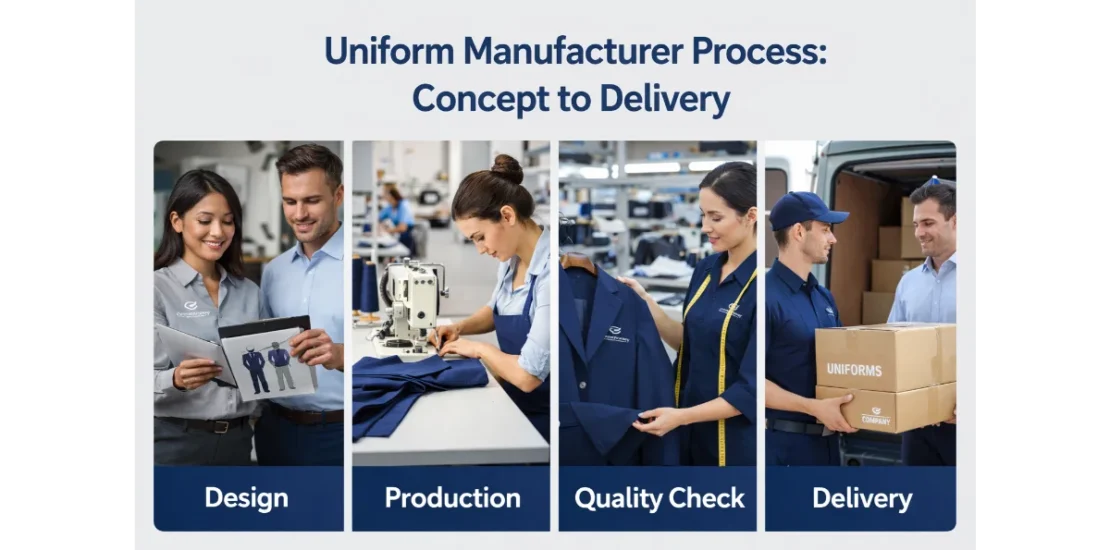
Bulk uniforms succeed when there is clarity behind the scenes. Here’s how the right process turns an idea into consistent, high-quality uniforms delivered on time.
Uniforms are more than just clothes. They mirror your brand, your values, and your corporate image. Buying in bulk means that you are not purchasing a single piece; rather, you are ensuring uniformity among teams, locations, and even future orders.
Businesses operating in several cities should collaborate with a systematic uniform manufacturer in India. When the process is unclear, minor errors can, in some cases, compound into major ones.
Hence, it is a good idea to know the concept, to, delivery workflow. It guarantees that every time there is ease, longevity, the right size, and brand conformity.
What is a uniform manufacturing process?
The uniform manufacturing process is a structured workflow that turns business requirements into finished uniforms delivered in bulk.
It usually follows these stages:
Consultation → Sampling → Approvals → Pre-production → Manufacturing → Quality Check → Warehouse Processing → Delivery
Each step has a clear purpose. Skipping one can lead to confusion, delays, or inconsistent results.
The uniform manufacturer process starts with understanding your needs, creating and approving samples, preparing for bulk production, manufacturing under quality control, and delivering uniforms in an organised manner.
Simple in structure. Detailed in execution.
What Happens During Consultation and Business understanding?
This stage sets the foundation.
Before fabric is cut or designs are finalised, the manufacturer must understand your business.
As a buyer, you should be ready with:
- List of employee roles
- Work environment (indoor, outdoor, industrial, guest-facing)
- Number of sets required per employee
- Branding guidelines
- Budget range
- Expected delivery timeline
A professional manufacturer will ask practical questions:
- Is the uniform meant to signal authority or hospitality?
- Will employees wear it for long shifts?
- How will sizing be collected?
- Will there be regular reorders for new joiners?
When this stage is handled properly, the rest of the process becomes smooth.
How Are Concepts Turned into Samples (and Why Sampling Saves Cost)?
After consultation, the design moves into sampling.
This usually involves:
- Finalising the concept
- Selecting fabrics
- Creating sample garments
Sampling allows you to test:
- Comfort during movement
- Fabric feel
- Colour accuracy
- Logo placement
- Pocket functionality
- Wash suitability
This is also where custom branding is validated. Embroidery placement, brand colours, and stitching details are checked before bulk production begins.
Sampling may seem like an extra step. In reality, it prevents expensive corrections later.
How do Refinement, Approvals, and Pre-production Reduce Surprises?
Once samples are reviewed, feedback is collected.
HR teams, procurement heads, and site supervisors may suggest small changes. This stage is called refinement and approval.
After approval, the process moves to pre-production.
Think of pre-production as a final readiness check before bulk manufacturing starts.
It confirms:
- Final fabric type
- Exact colour shade
- Logo size and placement
- Stitching specifications
- Size chart
- Trims and accessories
A helpful tip for businesses: create a uniform specification sheet. This document ensures future batches match the first order.
Pre-production reduces the risk of mid-manufacturing changes, which can be costly and time-consuming.
What Happens During Manufacturing, QC, and Warehouse Processing?
Now bulk production begins.
At a high level, the process includes:
- Fabric cutting
- Stitching
- Finishing
- Branding application
- Pressing
- Packing
But manufacturing alone is not enough. Quality checks are equally important.
During quality control, manufacturers check:
- Stitch consistency
- Size accuracy
- Logo alignment
- Overall finishing
Once quality is approved, warehouse processing begins.
This includes:
- Size-wise segregation
- Batch labeling
- Department-wise bundling
- Proper packing
Treating manufacturing and warehouse handling as separate stages ensures organised delivery.
How Does Delivery Work for Bulk Uniform Orders?
Delivery planning is often overlooked, but it matters.
For large teams, uniforms must be:
- Packed size-wise
- Clearly labeled
- Organised department-wise
Businesses should also plan for:
- Distribution across branches
- Buffer time before official rollout
- Reorder process for new employees
A structured delivery plan avoids last-minute chaos.
Does the Process Change by Uniform Type?
The core workflow remains the same. However, priorities shift depending on the industry.
Industrial uniform manufacturing
The fabrics should be durable, well-stitched, and easy to care for. These uniforms must withstand daily wear in demanding environments.
Hospital uniform manufacturing
In this case, cleanliness, breathability, and comfort are very important. Doctors, nurses, and support staff all have different designs.
Hotel uniform manufacturing
These uniforms must reflect brand presentation while also being comfortable for long shifts in roles that involve interacting with guests.
School uniform manufacturing
Being consistent is important. For future orders, it’s important to get the right size and colour.
Security uniform manufacturing
Structure and authority matter. At the same time, the uniform must remain comfortable for extended duty hours.
Housekeeping uniform manufacturing
Comfort, practicality, and wash durability are priorities. These uniforms go through frequent laundering.
Different industries demand different focus areas. That is why a flexible yet structured process is essential.
Consistency Comes from Process
Uniform quality is not accidental. It is the result of a well-defined workflow — consultation, sampling, approvals, pre-production, manufacturing, quality control, warehouse processing, and delivery.
When each stage is handled carefully, businesses receive uniforms that match their brand, fit their teams comfortably, and remain consistent in future reorders.
At Atvio, we follow a structured concept-to-delivery workflow so that nothing is left to chance. From understanding your business requirements to final dispatch, we maintain clarity at every step.
As a hospitality uniform supplier we produce uniforms across industrial, hospital, hotel, school, security, and housekeeping categories with custom branding options to reflect your identity.
We work with clients across Mumbai, Thane, Navi Mumbai, and nationwide. Our aim is to be recognised among the best uniform manufacturers in Mumbai and across India by keeping quality, comfort, and reliability at the centre of every order.
If you are planning a bulk uniform requirement, share your roles and specifications with us. Let’s begin with sampling and provide you with a clear and structured proposal.